
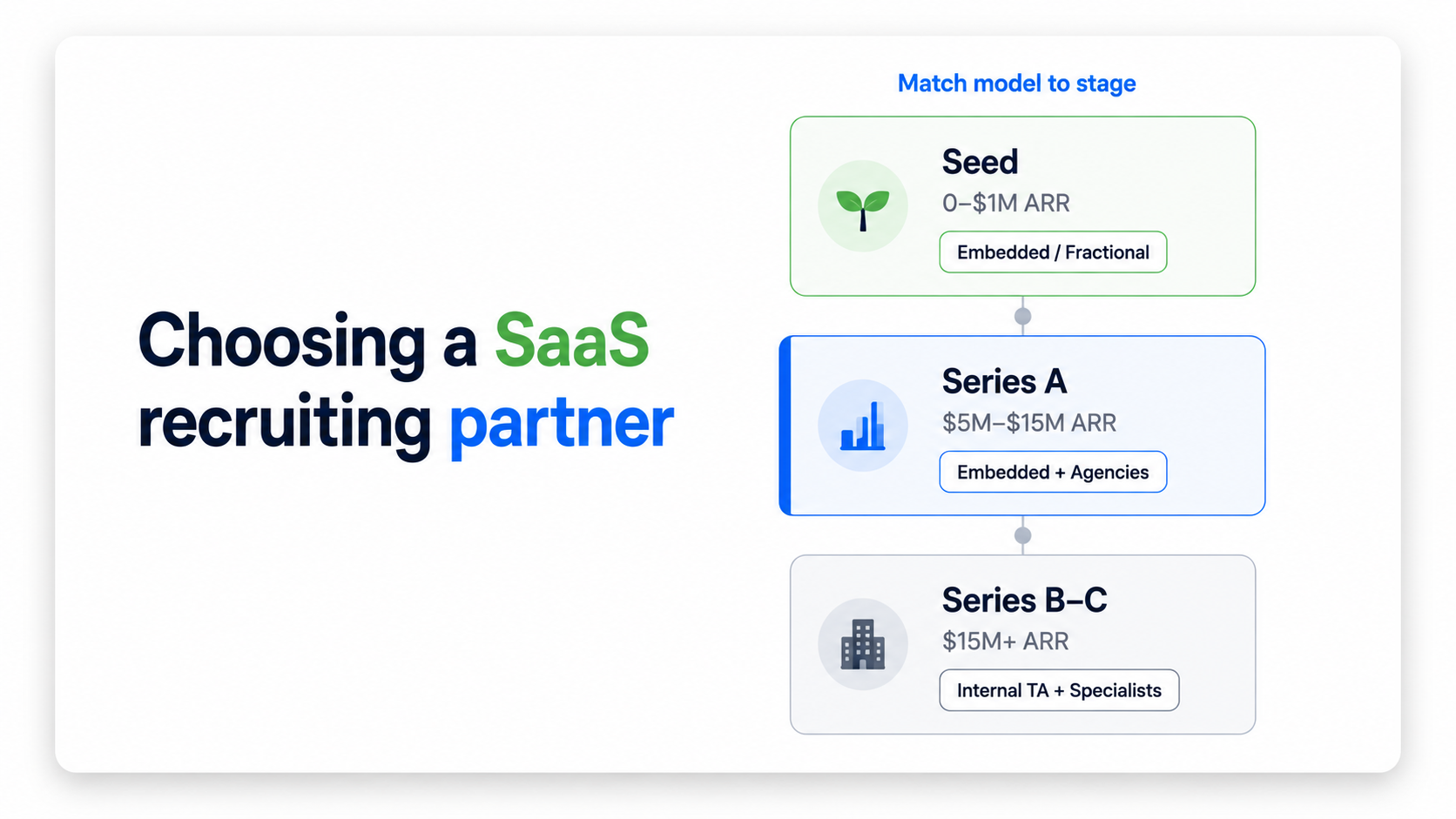
The right SaaS recruiting partner depends on your company stage, hiring volume, and role complexity. Seed-stage companies ($1M-$5M ARR) typically benefit from embedded recruiting partners who provide strategic guidance and quality over speed. Series A+ companies ($5M-$15M ARR) often use a mix of embedded partners for strategic hires and full-service agencies for volume or executive roles. Series B+ companies ($15M+ ARR) usually have internal recruiting teams and bring in specialized agencies for senior/executive searches.
This guide breaks down the models, decision criteria, and red flags so you choose the partner that actually fits your needs.
By the end, you'll know which model fits your company and what questions to ask before signing.
No single recruiting model is "best." The right model depends on your stage, hiring volume, and what support you actually need.
Full-Service Recruiting Agencies handle high-volume recruiting, often specialized by role - sales, exec search, tech. They serve Series B+ companies and companies hiring multiple roles simultaneously. Think Betts Recruiting for GTM and sales roles, Riviera Partners for executive search, Robert Half for volume hiring. Best for scaling teams quickly, executive searches, and roles with clear job descriptions. Typical engagement is contingent or retained search. Budget $25K-$75K+ per placement for contingent, $50K-$150K for retained exec search.
Embedded Recruiting Partners work as an extension of your team. They serve Seed-Series A companies making first key hires and tackling roles that are hard to define. Examples include Demand Recruiting (embedded partner for Seed-Series A SaaS). Best for strategic guidance on what to hire for, quality over speed, and first marketing, sales, or product hires. Typical engagement is hybrid (small retainer plus placement fee) or contingent. Budget $15K-$50K per placement.
RPO (Recruitment Process Outsourcing) takes over your entire recruiting function. Serves Series B+ companies hiring high volume; 10+ roles per quarter. Monthly retainer plus per-placement fees, typically $10K-$30K per month plus fees. Best for replacing or augmenting internal recruiting teams at scale.
Contingent Search Firms source candidates and get paid only on placement. Work with any stage but best for mid-level roles with clear job descriptions. No upfront cost; 20-25% of first-year salary on placement. Best for defined roles, mid-level hires, and when you have bandwidth to manage the process yourself. Budget $20K-$40K per placement on average.
Fractional Recruiting Support provides part-time recruiting help for sourcing and process management. Serves Seed-stage companies not ready for full agency support. Hourly or project-based engagement. Best for building pipeline, running interview processes, and sourcing support. Budget $5K-$15K per month for 10-20 hours per week.
At this stage, you're making first key hires. First marketer. First sales hire. Early engineers. You may not know exactly what you need yet. Every hire is make-or-break.
You need strategic guidance on what to hire for, not just someone filling a requisition. Quality matters more than speed. You need help defining the role, not just filling it.
Best models: Embedded recruiting partner (strategic guidance plus sourcing), fractional recruiting support (if bootstrapped or cash-tight), or DIY plus network mining (if you have strong network and time).
Budget reality: $15K-$50K per hire.
Red flags to watch for: Agencies promising 10+ candidates in a week (spray-and-pray approach). Recruiters who don't ask about your stage, PMF status, or growth plan. Volume-focused firms that want to fill multiple roles at once.
74% of startups fail due to premature scaling—hiring senior leaders before proving the model works. At Seed stage, resist the urge to hire for where you want to be instead of where you are.
At this stage, Demand Recruiting works with founder-led SaaS companies to define what the role actually needs to do at their stage, then sources 3-5 pre-vetted candidates who fit. This approach prioritizes getting the hire right over getting someone fast.
You're scaling critical functions. Building out marketing, sales, and engineering teams. You need a mix of strategic hires (first VP roles) and execution hires (ICs, managers). You're growing fast but can't afford mis-hires. Some roles are well-defined. Others need strategic input.
Best models: Embedded partner for strategic or first-in-function hires. Full-service agency for VP+ executive roles. Contingent search for well-defined IC or manager roles. Internal recruiter plus agency support (if hiring 5+ roles per quarter).
Budget reality: $50K-$150K total recruiting spend per quarter.
Red flags: Agencies that don't specialize in SaaS (won't understand PMF or GTM nuances). Recruiters who send generic candidates without tailoring to your stage. No placement guarantee or post-hire support.
31% of hiring leaders rank quality of hire as their top metric—speed and cost are secondary. In a selective market, companies prioritize getting the right person over getting someone fast.
Series A companies often use Demand Recruiting for their first VP Marketing or Head of Sales (strategic, hard-to-define roles) and larger agencies like Betts for VP Sales or exec searches where the role is well-defined.
You need specialized roles. Senior ICs. Niche technical expertise. Executive searches for C-suite and VP-level leadership. High volume hiring—building teams, not just filling roles. You have an internal TA team that needs external support for specialized or senior roles.
Best models: Full-service agencies for exec search (Riviera, Betts, specialized exec firms). RPO if hiring 10+ roles per quarter across multiple functions. Embedded partner for niche or strategic roles internal TA can't evaluate. Internal TA team handles most mid-level hiring in-house.
Budget reality: $150K-$500K+ annual recruiting spend.
Red flags: Generalist agencies without SaaS domain expertise. Recruiters who can't evaluate specialized skills your TA team lacks. Agencies that compete with your internal team instead of complementing them.
At this stage, companies typically have internal TA teams but bring in specialized agencies when they need deep domain expertise—like hiring a VP Product Marketing who understands PLG, or a Staff Engineer with specific technical stack experience.
Regardless of model or stage, ask these questions.
SaaS roles require unique competencies. PMF understanding. GTM fluency. Growth mindset. Generalist recruiters miss these.
Red flag: "We recruit across all industries."
Green flag: "We only work with B2B SaaS companies $1M-$100M ARR."
Resume screening finds qualified candidates. Strategic vetting finds the right candidates.
Red flag: "We match keywords and send you the top 10."
Green flag: "We assess for SaaS-fit, PMF understanding, and stage-appropriate experience."
Demand Recruiting's SaaS-fit assessment screens for product-market fit understanding, go-to-market fluency, and whether candidates have worked at similar company stages.
Guarantees demonstrate confidence in candidate fit.
Industry standard: 90-day guarantee with tiered refund or replacement.
Red flag: No guarantee or "30-day only."
Green flag: 90-day guarantee with clear replacement or refund terms.
Demand Recruiting's guarantee:
Most recruiting relationships end at offer acceptance. That's when onboarding challenges start.
Red flag: "We'll check in if you reach out."
Green flag: "We do 30/60/90-day check-ins with every placement."
Demand Recruiting does 6-month check-ins with every placement to ensure long-term success.
Industry benchmark: 30-45 days for mid-level roles, 45-60 days for senior/exec roles.
Red flag: "We'll have candidates in 3-5 days" (likely spray-and-pray).
Green flag: "4-6 weeks on average, depending on role complexity."
86% of job seekers research company reviews before applying. Poor candidate experience directly impacts your pipeline.
Red flag: Slow communication, ghosting candidates, generic pitches.
Green flag: 24-48 hour response times, tailored outreach, clear timelines.
Ask references:
Contingent: 20-25% of first-year salary, paid on placement
Retained: 30-33% paid in installments (upfront, midpoint, placement)
Hybrid: Small engagement fee plus reduced contingent percentage
Red flag: Unclear pricing, hidden fees, unwilling to discuss cost upfront.
Green flag: Transparent pricing discussed in first call.
Volume over quality approach. "We'll send you 10-15 candidates in the first week." Translation: They're spraying resumes, not vetting strategically.
No SaaS specialization. "We recruit across all industries—tech, healthcare, finance, etc." Translation: They don't understand SaaS-specific competencies.
No discovery process. Jumps straight to sourcing without asking about your stage, PMF, growth plan, or team structure. Translation: They're filling a requisition, not solving a hiring problem.
Generic candidate pitches. Sends same candidates to multiple similar companies. Doesn't tailor candidate selection to your specific needs.
No placement guarantee. "We stand behind our work" but no formal guarantee. Translation: Not confident in their vetting process.
Poor communication. Takes 3+ days to respond. Ghosts candidates or doesn't keep you updated. Translation: You'll waste time chasing them.
Who we serve: Founder-led and growth-stage B2B SaaS companies ($1M-$100M ARR). Primary focus is Seed-Series A companies making first key hires. Roles include marketing, sales, engineering, product, operations, and customer success.
Discovery-first methodology. We understand your stage, PMF status, and growth plan before sourcing. We define what the role actually needs to do at your stage (not generic job description). We map required competencies to your specific context.
SaaS-fit assessment. We screen for PMF understanding (do they get your stage?). We assess GTM fluency (can they speak to ICP, positioning, channels?). We evaluate stage-appropriate experience (have they operated at similar scale?).
Quality over speed. Pre-vetted finalists: 3-5 candidates (not 10-15 spray-and-pray). Average time-to-hire: 4 weeks. Focus is getting the hire right, not just filling the seat fast.
Placement guarantee plus ongoing support. 90-day guarantee with tiered refunds and replacements. 6-month check-ins with every placement. Partnership approach: We succeed when your hire succeeds.
Track record: 20+ founder-led SaaS companies served. Specialize in first marketing hires, first sales hires, and early engineering leads. Experience across $1M-$100M ARR range.
When to work with us:
When NOT to work with us:
Schedule a 45-minute strategy session to discuss your hiring needs.
Strong existing network. Your team has 250+ qualified contacts per person. Network mining works. You have time to systematically mine connections. Each employee's network yields 25-50 qualified prospects in 30 minutes.
Well-defined role plus bandwidth. You know exactly what you need. You have 10-15 hours per week to dedicate to recruiting. You can manage candidate experience (respond within 24-48 hours).
Early stage plus cash-tight. Pre-$1M ARR, bootstrapped, limited recruiting budget. First 1-2 hires where founder network is strong.
Role is hard to define. First marketing hire. First sales hire. First product hire. You're not sure what level to hire (IC vs. manager vs. VP). You need strategic guidance on what the role should do.
Network isn't yielding candidates. You've exhausted warm intros. Role requires specialized skills your network doesn't have.
Time is the constraint. You're spending 20+ hours per week recruiting and it's pulling you away from running the business. Hiring is taking 60-90+ days and costing you momentum.
You've made a bad hire before. Mis-hire cost you 6-12 months and $100K-$240K. You want strategic vetting, not just resume screening. Bad hires cost an average of $240K (recruiting, onboarding, ramp, lost productivity). Most leave within 6-12 months.
Step 1: Assess your needs. What stage are you? (Seed / Series A / Series B+). What role(s) are you hiring for? Is the role well-defined or do you need strategic input? What's your timeline and budget?
Step 2: Identify the right model. Use the stage-based framework above. Match your needs to the model that fits.
Step 3: Vet 2-3 partners. Ask the 8 key criteria questions (see "Key Criteria for Evaluating Any Recruiting Partner" section above). Request references and actually call them. Evaluate specialization, process, guarantee, and support.
Step 4: Start with one strategic hire. Don't commit to 5 roles upfront. Test the partnership on one critical hire. Evaluate quality, communication, and candidate experience.
Step 5: Build the relationship. Best recruiting relationships are long-term partnerships. The recruiter who places your first marketer can help you scale the marketing team over 2-3 years. Treat it like a strategic partnership, not a transaction.
Schedule a 45-minute strategy session with Demand Recruiting to discuss your hiring needs and determine if we're the right fit.

Specialized recruiting partner for growing SaaS companies needing talent that drives real results.


