
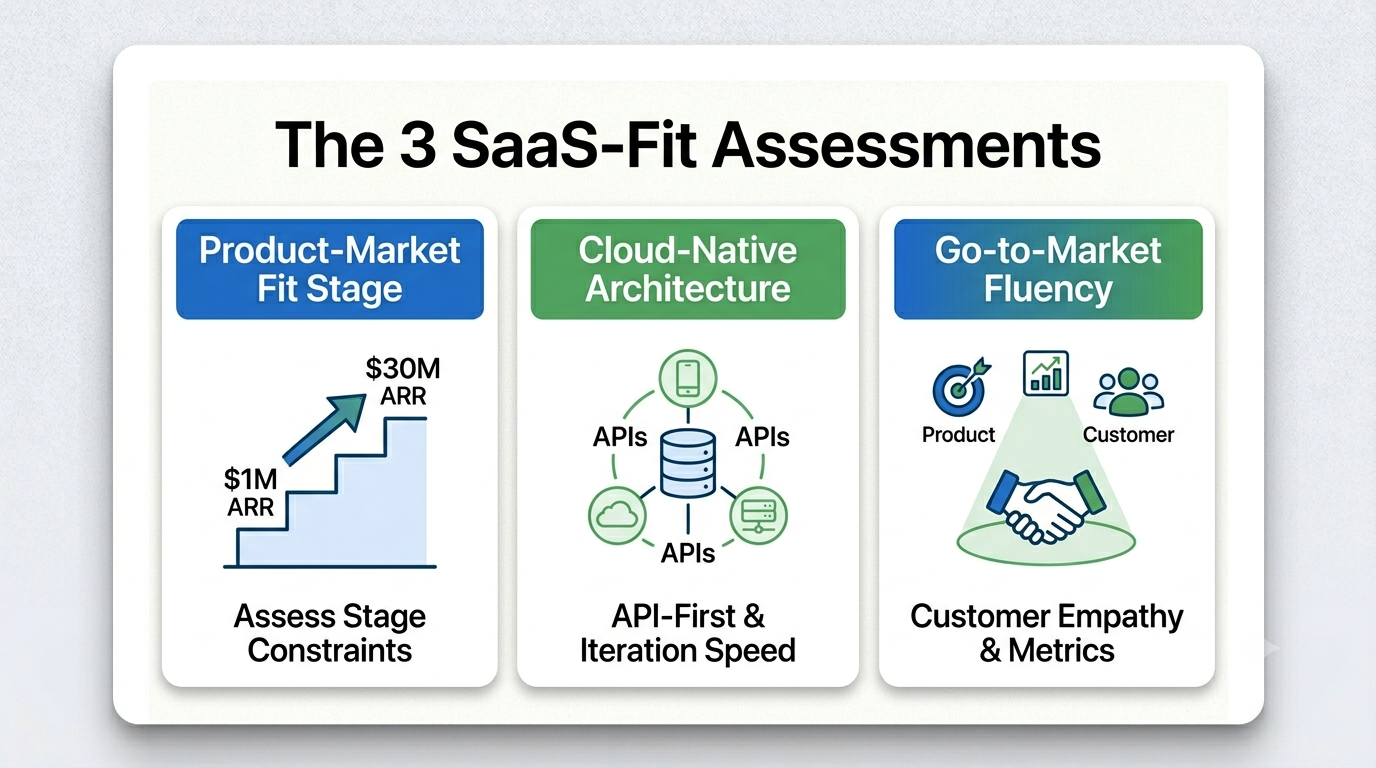
The best headhunters for technical SaaS hiring understand the critical difference between hiring a senior engineer for an enterprise software company and hiring for a growth-stage SaaS company. They assess for product-market fit understanding, cloud-native architecture experience, and the ability to work in fast-iteration environments—not just coding ability. Look for recruiters who specialize in $1M-$100M ARR B2B SaaS (not just "tech" or "software"), understand your growth stage constraints, and can evaluate candidates on SaaS-specific competencies like go-to-market fluency, not just resume keywords.
Here's the challenge. Most tech recruiters treat all software companies the same, whether you're building enterprise software, services-based products, or a growth-stage SaaS platform.
The reality is SaaS companies require different technical competencies than enterprise software or consulting firms. Cloud-native architecture, API-first design, and product iteration speed matter more than traditional waterfall development patterns. Engineers need go-to-market fluency - understanding ICP, positioning, and product-market fit stage - not just coding chops. Hiring for a $3M ARR company requires different seniority and skill sets than hiring for a $30M ARR company scaling to $100M.
Generic tech recruiters optimize for resume keywords ("Python," "React," "5+ years experience") instead of context ("built 0→1 products at PMF stage," "shipped weekly in resource-constrained environments," "understands trade-offs between speed and scale").
69% of engineering leaders believe strong engineers are worth 3x their salary (iMocha, 2026). That ROI only happens when you hire engineers who understand your specific SaaS context. The wrong hire doesn't just cost you money, it sets you back 3-6 months while you realize the mistake, off-board, and start over.
Consider the numbers. AI Engineer is the fastest-growing job title in 2026 (LinkedIn), yet only 19% of tech job titles exceed pre-pandemic posting levels. The market is selective. Competition for the right engineers is fierce. You can't afford to waste time interviewing candidates who don't understand what it means to build for SaaS.
70% of high-growth startups show signs of premature scaling (Startup Genome). In hiring, that looks like bringing in a VP Engineering before you need to manage managers, or hiring senior engineers from Fortune 500 enterprise backgrounds who can't adapt to weekly ship cycles.
The pattern repeats. Founders hire "senior engineers" based on resume credentials, then watch them struggle to operate in cash-constrained, fast-iteration SaaS environments. A specialized SaaS recruiter screens for this upfront.
Deep expertise means understanding stage-specific needs, not just generic tech hiring.
A recruiter with deep SaaS expertise knows the difference between hiring for $1M-$5M ARR (first engineering hires, generalists who can wear multiple hats, bias toward shipping speed) and $15M-$50M ARR (specialized roles, system scalability, manager vs. IC decisions) and $50M+ ARR (building teams, optimizing for leverage, executive technical leadership).
They know when to hire a senior IC vs. an engineering manager vs. a VP Engineering. They understand you don't need a VP until you're managing managers - inflating titles prematurely creates downstream problems when you need to hire above that person later.
They assess for SaaS-specific technical competencies:
They help you avoid premature scaling mistakes. Hiring a VP Engineering when you're at $2M ARR and have three engineers is premature. You need senior ICs who can ship, not managers who coordinate. Good recruiters push back when you're about to make an expensive mistake.
They understand founder-led vs. VC-backed constraints. Bootstrapped companies optimize for cash efficiency and hire generalists. VC-backed companies can afford specialists earlier but need to move fast before burning runway. Budget, speed, and culture fit all look different depending on funding stage.
A common mistake looks like this. Founder hires a "senior engineer" from Salesforce or Oracle - big enterprise background, impressive resume. That engineer struggles in a SaaS environment where "ship fast, iterate based on customer feedback" trumps "build comprehensive specs, six-month release cycles." They're a bad fit not because they lack skills, but because the context is wrong.
What good looks like is an engineer who's built 0→1 products, understands PMF stage constraints, can wear multiple hats, and thrives in ambiguity. A specialized SaaS recruiter knows how to screen for this.
Watch for recruiters who can't differentiate between SaaS, enterprise software, and consulting/services companies. If they're sending you candidates from Fortune 500 enterprise backgrounds for your $5M ARR startup, they don't understand context.
They can't explain the difference between hiring for Seed stage vs. Series B. Ask them "What's different about hiring a senior engineer at $3M ARR vs. $30M ARR?" If they can't articulate stage-specific trade-offs (generalist vs. specialist, speed vs. scale, scrappy vs. systematic), they're winging it.
They focus on resume keywords ("5+ years Python") instead of context ("built scalable systems at growth-stage SaaS companies, comfortable with ambiguity and resource constraints").
They don't ask about your product-market fit stage, ARR, or growth constraints upfront. A good recruiter needs to understand where you are and where you're going before they can evaluate whether a candidate fits. No questions about PMF = no SaaS expertise.
They use generic job descriptions without stage-specific customization. A senior engineering role at $2M ARR looks nothing like the same title at $50M ARR. Generic JDs signal the recruiter doesn't understand nuance.
They offer no placement guarantee or post-hire follow-up. One-and-done recruiters optimize for placement fees, not long-term fit. If they disappear after the hire starts, they don't care whether it works out.
Contrast this with what good SaaS recruiters do. They ask about PMF stage, ARR, and growth trajectory first, before talking about candidates. They customize role requirements based on your specific stage and constraints. They screen for SaaS context (product thinking, iteration speed, go-to-market fluency) not just resume matching. They provide placement guarantees (90 days minimum) and check in post-hire to ensure success. They have a portfolio of SaaS placements at similar stages, not just tech companies broadly.
Ask these questions upfront.
"What SaaS companies have you placed technical roles for? What stages and ARR ranges?" Look for specific examples: company names, stages, outcomes. Vague answers ("we work with lots of tech companies") mean no SaaS specialization.
"How do you assess whether a candidate understands product-market fit?" Good answer: They ask candidates to describe PMF at their previous company, explain trade-offs between speed and perfection, give examples of shipping under resource constraints. Bad answer: Blank stare or generic "culture fit" language.
"What's the difference between hiring a senior engineer at $3M ARR vs. $30M ARR?" Good answer: $3M needs generalists who can wear multiple hats and ship fast; $30M needs specialists who can build scalable systems and may manage other engineers. Bad answer: "Senior engineers are senior engineers."
"Do you offer a placement guarantee? What does it cover?" Good answer: 90-day guarantee minimum, tiered refunds or free replacement if the hire doesn't work out. Bad answer: No guarantee or vague "we stand behind our placements."
"How do you stay engaged post-hire to ensure success?" Good answer: 30/60/90-day check-ins, availability for onboarding questions, proactive follow-up. Bad answer: "We're always available if you need us" (reactive, not proactive).
Green flags to look for:
If a recruiter can speak your language - ARR stages, PMF constraints, CAC payback, channel efficiency - they've worked inside SaaS companies. If they can't, they're learning on your dime.
Traditional technical interviews are broken.
"The Last Technical Interview" by Steve Yegge documents the failures of traditional technical interviewing - where Google interviewers unknowingly rejected their own interview packets when presented anonymously. If Google's own interviewers can't recognize qualified responses from their own team, what does that say about the validity of whiteboard coding challenges?
Generic tech recruiters rely on these broken processes. Whiteboard coding, trivia questions, algorithmic puzzles that measure interview preparation and performance anxiety - not actual engineering ability.
Better approaches exist. Work samples, trial projects, paid test assignments. Real code review of actual work the candidate has shipped. Structured system design discussions that reveal how they think about scalability, trade-offs, and technical debt.
Good SaaS recruiters help you design interview processes that assess real competencies:
Your job is to assess whether candidates can do the actual work your company needs, not whether they've memorized LeetCode solutions. A specialized recruiter helps you build that process.
Founders rush. They hire the first recruiter who promises fast results without vetting SaaS expertise. Speed matters, but hiring the wrong recruiter costs you more time than doing it right upfront.
They assume all tech recruiters understand SaaS. They don't. Most recruiters treat software companies as interchangeable. SaaS-specific expertise is rare.
They skip reference checks. Ask for references from other SaaS founders who've worked with the recruiter. Backchannel conversations reveal whether they actually deliver on promises.
They accept generic job descriptions without stage customization. If a recruiter hands you a template JD without asking about your stage, constraints, and growth trajectory, push back. Generic JDs attract generic candidates.
They skip work trials and thorough reference checks during the hiring process. Fast hires often become slow fires. A good recruiter insists on structured evaluation - work samples, backchannel references beyond candidate-provided contacts, clear success criteria.
They don't define success metrics upfront. What does success look like at 30/60/90 days? If you and the recruiter haven't agreed on this before the hire starts, you're setting up for misalignment.
What to do instead:
Getting technical hiring right compounds. A great engineering hire builds systems, mentors junior engineers, attracts other strong engineers. A mediocre hire kills team morale and velocity. Your recruiter either helps you identify the difference or costs you six months.
We focus exclusively on $1M-$100M ARR B2B SaaS companies. Not generic tech. Not enterprise software. Not consulting firms. SaaS.
We customize role requirements based on your PMF stage, ARR, and growth trajectory. A senior engineer at $3M ARR needs different skills than the same title at $30M ARR. We start with discovery - understanding what you actually need before sourcing begins.
We assess for SaaS context, not just resume keywords. Product-market fit understanding. Go-to-market fluency. Cloud-native experience. Can they articulate your ICP? Do they understand the trade-offs between moving fast and building for scale? Have they worked in resource-constrained environments where every decision has opportunity cost?
Our approach is consultative, not transactional. We help you define what you need before we source candidates. We push back when you're about to make premature scaling mistakes - like hiring a VP Engineering when you need senior ICs who can ship. We deliver strategic guidance on role definition, not just candidate volume.
We prioritize quality over speed. We deliver 8-10 pre-vetted finalists, not 50 unscreened resumes. Your job is to interview the right people, not filter through noise.
We reduce risk with a 90-day placement guarantee. Tiered refunds if the hire doesn't work out in the first 90 days (full refund days 0-30, 66% days 31-60, 33% days 61-90). We're confident in our vetting process because we screen for SaaS fit, not just technical skills.
We don't disappear after placement. Six-month check-ins ensure long-term success. We're available for onboarding questions, performance discussions, role adjustments. We care whether the hire works out, not just whether we get paid.
Our track record includes engineering, product, and go-to-market roles for founder-led and growth-stage SaaS companies. We understand the cross-functional collaboration SaaS teams require. We've been inside SaaS companies for 5+ years and we know your constraints firsthand, not from a textbook.
What differentiates us from high-volume recruiters like Riviera Partners or Betts Recruiting: We're not optimizing for speed and volume. We're optimizing for fit. Smaller client load means deeper partnership. We treat every search as strategic, not transactional.
Before you commit to a recruiter, run this checklist:
The difference between a great technical hire and a mediocre one is enormous. One builds systems that scale, mentors your team, and attracts other strong engineers. The other tanks morale and sets you back six months.
Your recruiter either helps you identify that difference or costs you time, money, and momentum. Get specific. Get honest. Make sure they understand SaaS and not just tech.
Schedule a 45-minute strategy session and we'll work through your specific technical hiring needs together. Let's talk.

Specialized recruiting partner for growing SaaS companies needing talent that drives real results.


