
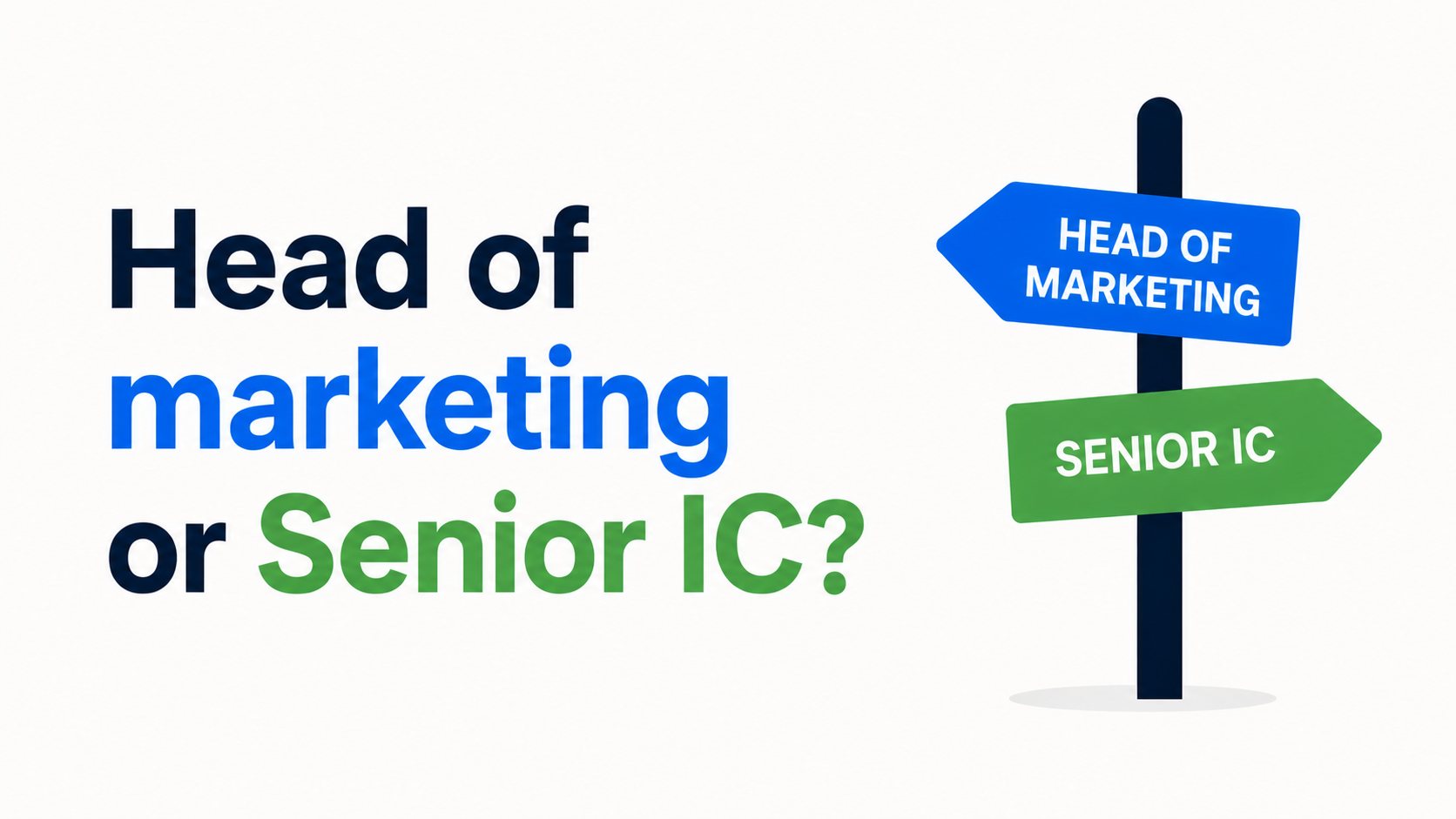
You've decided you need marketing help.
Maybe you're the founder and you're still carrying too much of the pipeline burden yourself. Maybe sales is asking for better positioning, more consistent demand, and actual enablement. Maybe you've got traction, but marketing is still a mix of founder posts, ad hoc campaigns, and whatever got done this week.
That's usually when the title conversation starts.
Do we need a Head of Marketing?
A VP?
A senior demand gen person?
A product marketer?
Someone who can do a bit of everything?
Most founders don't actually start with a role. They start with a feeling that growth is stalling somewhere and marketing should probably fix it. That's a problem.
Most founders hire for a title rather than a specific business problem. That's how you end up six months in with an expensive hire, fuzzy expectations, and no real change in pipeline.
The difference between a great marketing hire and a mediocre one is enormous. One compounds. The other costs you a year.
If you're a founder-led or growth-stage SaaS company in the $3M-$10M ARR range, this is one of the highest-leverage hiring decisions you'll make. Every hire at this stage is funded by revenue or tightly managed capital. You can't afford to get it wrong.
Let's break down how to think about it.
A pattern I see often is founders saying they need a "Head of Marketing" when what they really need is one of these:
Those are not the same job.
This is where a lot of hiring advice falls apart. It assumes you already know whether you need leadership, execution, or specialization. Most founder-led teams don't. They know something is broken, slow, or not scaling. They just haven't translated that into a real role yet.
Your job before you hire is to get specific, get honest, and define what this person needs to do in the next 12 months. What does the business need now?
At $3M-$10M ARR, a true Head of Marketing is usually not just your best marketer. They are a functional leader.
That usually means they are responsible for:
They may still do hands-on work early. In smaller SaaS companies, that's normal. But if they're the right level, their real value is not shipping everything themselves. Their value is designing the system, prioritizing correctly, and making the next few hires smarter.
That sounds great. Sometimes it is.
But here's the tradeoff. Senior hires take time to ramp. If you're expecting a Head of Marketing to walk in and materially change pipeline in 60 to 90 days, you may be hiring for the wrong level or expecting the wrong thing. Senior leaders often need time to learn the market, earn trust, assess what's working, and build around it. That's much slower than hiring a strong operator to go execute.
If you don't have the patience, runway, or internal clarity for that kind of ramp, a Head of Marketing may be too much role and not enough immediate output.
A strong senior IC is a different kind of solve.
This person is usually closer to the work. They might own demand gen, lifecycle, product marketing, or content with real depth in one area and enough range to collaborate across the rest.
In practical terms, they're more likely to:
If your biggest problem is "we need more consistent execution and more signal on what works," a strong IC is often the better first move.
This is especially true for founder-led SaaS companies around $3M-$5M ARR where the marketing motion still isn't fully proven yet. At that stage, you're often not ready for a full department head. You're still figuring out which channels actually produce qualified pipeline, what your positioning needs to say, and how much budget the motion can support.
In other words, you may need someone to help discover the motion before you hire someone to scale it.
Here's the framework I'd use.
Start here.
Is the problem:
Different problems point to different hires. Pipeline execution and agency management? Hire an IC. Positioning, cross-functional alignment, and team orchestration? You need a Head of Marketing.
What usually doesn't work is trying to solve both with one under-scoped job description.
This is the question that matters most.
If you are still discovering the motion, you probably need:
If you already have some repeatability and need to build a more durable function around it, that's when a Head of Marketing starts to make more sense.
A lot of companies hire the leader too early because they want maturity. But maturity doesn't come from titles. It comes from clarity, repeatability, and smart sequencing.
This is where founders need to be honest.
If you still want to own:
then you are probably not ready for a real Head of Marketing.
You may want someone senior. You may want someone strategic. But if you're not ready to hand over meaningful ownership, you're more likely looking for a senior IC who can partner with you closely.
That's completely valid.
What creates problems is hiring a Head of Marketing and then quietly treating them like an executor with a nicer title.
A hard truth. The "full-stack" marketing leader a lot of companies imagine does not exist at an early-stage SaaS salary band.
A product marketer who can also run demand gen, write your content, manage agencies, own lifecycle, and act like a VP does not exist at $85K. Or if they do, they are not good at all of those things.
At this stage, your budget should tell you something about the likely level of hire, the support they'll need, and the scope you can realistically expect.
Before you hire, answer:
If your expectations and your budget don't match, that's not a recruiting problem. That's role design.
There are a few patterns here.
Sometimes the company hires a Head of Marketing because it feels like the next grown-up move.
Board wants it. Founder feels behind. Team wants leadership.
But if the real need is someone to build pipeline or clean up execution, the result is predictable. The new leader spends their time in planning, prioritization, and alignment. The work underneath still doesn't happen consistently. The founder gets frustrated. The hire feels boxed in.
That's not a people problem. It's a mismatch.
This one shows up all the time in job descriptions.
The company wants:
That's multiple roles jammed into one req.
When companies hire this way, they usually get one of two outcomes: a weaker candidate than they hoped for, or a long search that drags because the market can tell the role isn't real.
If the new hire starts and success still sounds like "own marketing," you're in trouble.
Success needs to be specific.
Think:
Without that clarity, you can't tell if the hire is wrong, the strategy is wrong, or you're just impatient.
Before you write the job description, answer these in writing.
If you can't answer these, you're not ready to choose a title yet.
You're still defining the job.
If I had to simplify it:
If you're in the $3M-$5M ARR range and still proving what works, start by looking hard at a strong senior IC or player-coach.
If you're closer to $7M-$10M ARR, have some repeatability, and need someone to build the function around it, a Head of Marketing may make sense.
If you're not sure whether the problem is strategy, execution, or specialization, stop arguing about titles and go back to the business problem.
That's where the answer usually is.
This is exactly the kind of hire where generalist recruiting usually falls down.
Traditional recruiters can source candidates. The problem is they often can't help you answer the harder question first: what role do you actually need at this stage, and what does good look like for this company?
That's the part I care about.
Demand Recruiting works best when the role is hard to define, hard to evaluate, or too important to get wrong. We use a discovery-first approach to help founder-led and growth-stage B2B SaaS teams clarify the job, map the strengths that matter, and then run a search built around fit, not volume.
We're not trying to send you 50 resumes and hope something sticks.
We're trying to help you make the right hire.
Because the wrong marketing hire doesn't just cost salary. It costs momentum, clarity, and a chunk of the year you don't get back.
Here's how Demand Recruiting handles marketing leadership recruiting, from defining the role to closing the offer.
If you're trying to figure out whether you need a Head of Marketing, a strong IC, or a different role entirely, schedule a 45-minute strategy session. We'll work through your stage, your goals, and what this hire actually needs to do. Then you can move forward with a lot more confidence.

Helping B2B SaaS founders and GTM leaders hire the sales, marketing, and RevOps people who move growth forward.


