
By Kim Talarczyk, founder of Demand Recruiting
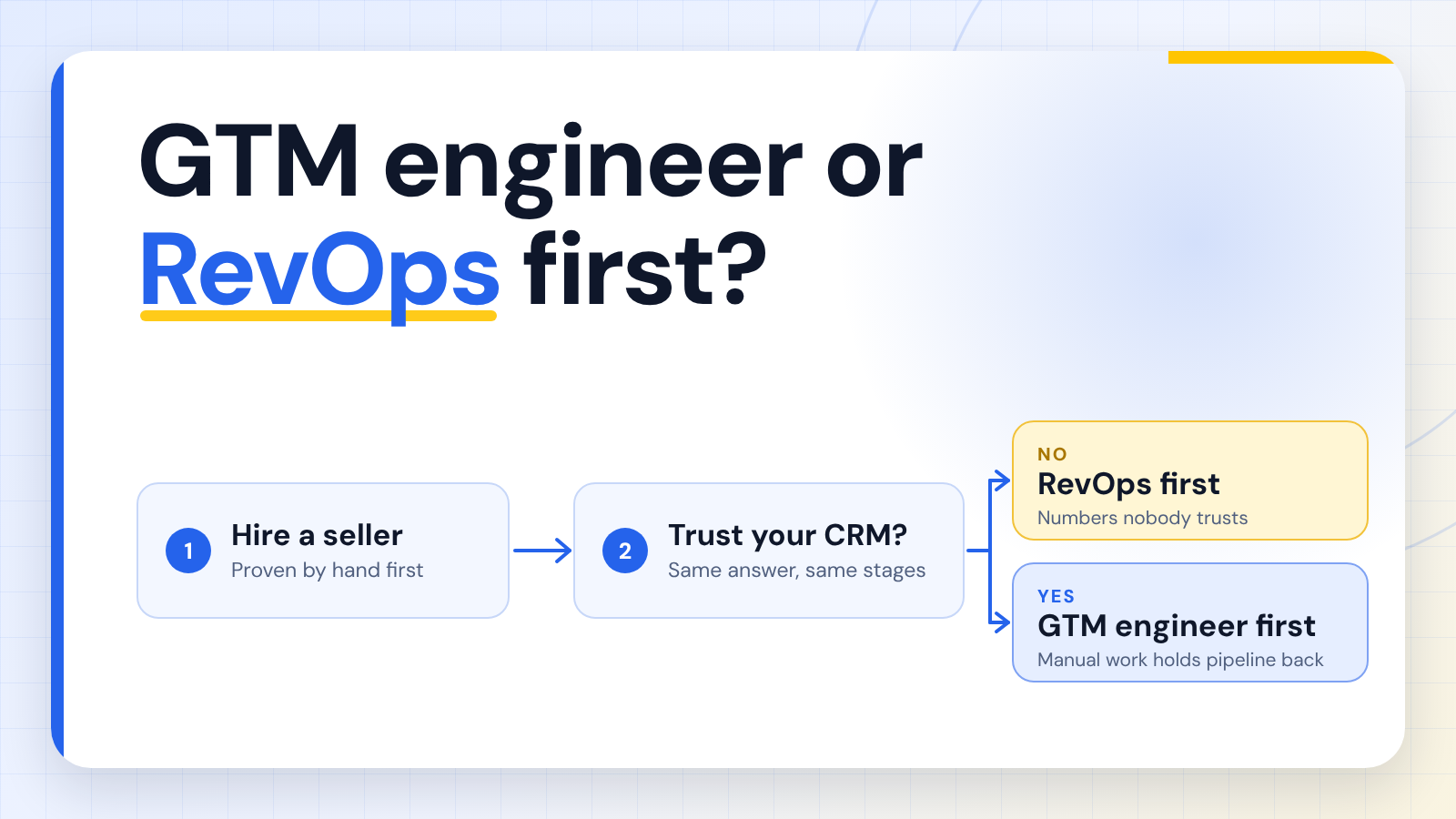
I would hire a seller before either one, because neither role can find a motion nobody has proven by hand. After that, if nobody trusts the numbers or the CRM, I would hire RevOps first. If the CRM works and pipeline is stuck on manual work, I would hire a GTM engineer first, and I recruit it as its own role.
A RevOps lead builds the system around how your deals close, and a GTM engineer automates work a seller already does by hand. If nobody has closed the same kind of deal more than once, neither of them has anything to build around. You’d just be automating a guessed motion.
So the first GTM seat is a person who sells, usually your first AE. That's the same order I see in the first 5 GTM hires, and it holds when the tempting option is software, which is why a person comes first in AI SDR or human SDR too. If the sales process itself still needs building, you may want to consider some fractional help (check out the partners I trust), before you hire anyone.
Pull your pipeline twice in the same week and see if you get the same answer. Ask people on your team what a stage means and see if they agree. If either one fails, I would hire RevOps first. Anything a GTM engineer builds will feed a CRM nobody believes, and you'll end up with more records you can't use.
In this case I would hire a RevOps lead and hold the GTM engineer until the forecast holds up.
The CRM works. Reports match, stages mean the same thing to everyone, and the motion books meetings. But your sellers lose the week to building lists, researching accounts, copying data between tools, and routing leads by hand.
That's when I would hire a GTM engineer first. Another seller in that motion usually just adds another person doing the same manual work. A GTM engineer builds the systems that take it off your sellers' plate so they can spend more time selling.
| RevOps | GTM engineer | |
|---|---|---|
| What they own | The revenue system, the CRM, stage definitions, the forecast, and handoffs | The systems that create pipeline, like lists, research, data flow, and routing |
| When they come first | Nobody trusts the numbers or the CRM | The CRM works and manual work holds pipeline back |
| What they fix | Numbers your team can't agree on | Seller time lost to manual work |
RevOps keeps the revenue system honest, and a GTM engineer builds the systems that create pipeline. I recruit them as different roles, with different interviews and a different shortlist. A RevOps lead who has written a few automations is not a GTM engineer, and the reverse is true too.
At a small company the job post often asks for both. When a job post asks for both, I would hire for the job that is broken today and write the other one down as a later seat.
When a candidate says they do both, I ask which one they were hired to fix last time, and what was different when they left. The answer tells me which job they're strongest at, and that should match the job that's broken on your team.
Sometimes the work isn't a full-time job yet. If it's one CRM cleanup or one build, Kevin at Revductive, one of the partners I trust, does part-time RevOps and AI systems work without you adding a seat. If you're still deciding whether you need RevOps at all, or whether fractional is enough, I go through that in hiring RevOps in B2B SaaS.
Once the work fills every week and keeps coming back, it's a hire.
Most of the companies I work with are B2B SaaS under $10M ARR. If the CRM is the problem, start with how I hire a RevOps lead. If it's manual work, start with how I hire a GTM engineer. The hiring framework is a practical place to decide what the seat needs before the req opens, and if it's one seat, you can start with a single search.
Tell me where things stand, and I'll reply within one business day.

Helping B2B SaaS founders and GTM leaders hire the sales, marketing, and RevOps people who move growth forward.


